
The 6–12 Month SEO Dip: Why Rankings Wobble Before They Stick
There’s a pattern we’ve seen consistently across campaigns over the past two years. Somewhere between the five and nine month mark, rankings get messy. A keyword that was tracking upward is suddenly sitting at position 11. Then 8. Then 13. Then 7. All within the same fortnight. Nothing obviously changed on the site. No penalty notifications, no algorithm update emails.
Most people assume they’ve done something wrong.
They haven’t.
What the Data Actually Shows
The two graphs below are from a real campaign we’re running right now, roughly at the seven month mark. Both keywords have been tracking upwards throughout the early phases of the campaign, starting from outside the top 100 and rising all the way to page 1 of Google. But comparing end of May to end of June, both show drops back out of the top 10. Several other keywords showed drops across the month. This could be concerning (even alarming) for a business owner just looking at the data on the surface.
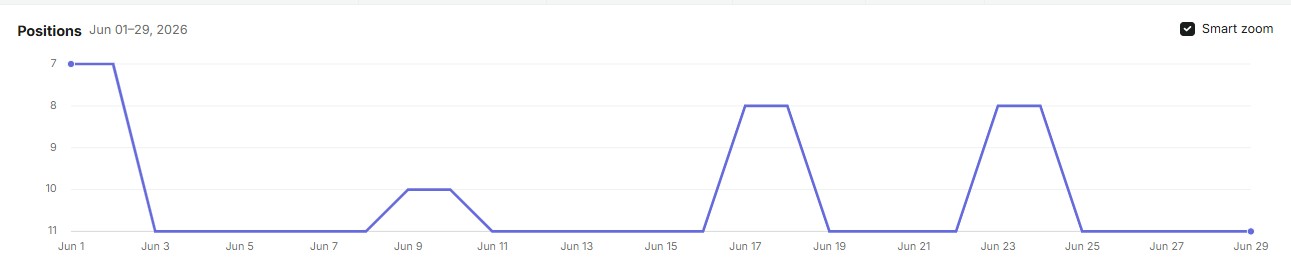

But look at the shape of the movement. These aren’t rankings drifting downward and staying there. They’re bouncing – up several spots, down several spots, up again – multiple times across the month. That’s a different problem entirely. Or rather, it’s not a problem at all. This is sometimes called ranking flux, and it’s more common than most campaign reports suggest.
A genuine decline looks like a slow slide with no recovery. What you’re seeing here is a page being actively tested by Google: placed at different positions on different days, with Google observing how searchers respond each time. Click-through rate, time on site, whether users come back to search again. All of it feeds back into where the page eventually lands.
Why This Happens in the 5–9 Month Window
When a campaign is new, the site doesn’t have enough authority for Google to bother stress-testing the rankings. Pages either don’t rank or they rank low, and they stay there.
As authority builds through consistent link acquisition and quality content, something shifts. Google starts treating the pages as contenders for better positions. And that’s exactly when the volatility kicks in.
When a site is moving up and down and back up and back down again in the rankings, this isn’t a bad thing. Google is actively re-evaluating a page’s authority — it tests different positions, observes engagement signals, and gradually settles.
It’s a reasonably reliable signal that the SEO campaign is working. Most websites show this kind of volatility somewhere in the five to nine month window, especially when building authority from a low base. In virtually every case, rankings settled into an improved position on the other side. Not always immediately, and not without continued investment in the campaign, but the pattern holds.
The mistake is pulling back when you see the wobble. That’s the worst possible timing.

What Stabilises Rankings Faster
The short answer is link building.
Guest posts placed on real, relevant, actively trafficked websites give Google something concrete to assess. A page bouncing between positions 6 and 11 has the content but not yet the authority to hold the better spot consistently. Quality links shift that calculation. They’re not a background activity to keep ticking over. In this phase they’re the primary lever.
Not all links answer it equally. A placement on a real, actively trafficked site in a relevant industry carries significantly more weight than a directory listing or a generic profile link. That’s why the budget allocated to link acquisition matters. Campaigns that can invest in regular, quality guest post placements through this phase tend to stabilise faster and land at better positions than those that slow down or stop.
Over the past two years, we’ve seen around three quarters of campaigns show volatility at some stage during the five to nine month window, and nearly all of them stabilised in the rankings after this period. The key factor in how quickly they stabilise is almost always the consistency of quality link building through that phase.
How to Read Your Own Rankings During This Phase
If your campaign is in this window, a few things worth checking before drawing conclusions:
Look at the movement, not just the position. A snapshot ranking on the last day of the month doesn’t tell you much. Pull the day-by-day data and see whether the movement has a bounce shape or a slide shape.
Look at the trend over a longer window. A volatile month in June usually still shows a better average position than the same month in January. Pull that comparison before drawing conclusions from the noise.
Snapshot rankings mislead. Position 11 on a Tuesday doesn’t mean much in isolation – the same keyword might be at 7 on Thursday. What matters is the longer-term trend: where the average sits this month compared to several months ago.
The volatility phase isn’t a reason to change strategy. It’s a reason to hold it.
Share this article
A quick overview of the topics covered in this article.
Latest articles
October 5, 2026

October 5, 2026