There’s free money hiding on page 2 of Google. Here’s exactly how to find it.
The clicks aren’t evenly distributed across Google’s results. Position 1 captures roughly 28% of all clicks for a given search. Position 11 — the first result on page 2 — gets less than 1%. That gap is enormous, and it’s where a lot of businesses quietly bleed traffic they could have had.
The instinct most business owners follow is to chase brand-new keywords. Find something they’re not ranking for at all, write content, hope it sticks. That’s not wrong exactly — it’s just slow. You’re starting from zero, competing against pages with years of authority behind them.
Page 2 rankings are a different problem entirely.
You’re already doing the hard part — you just don’t know it
A keyword sitting in position 12 or 18 means Google has already read your site, decided you’re relevant, and placed you somewhere in the results. The trust is partially there. The work isn’t starting from scratch — it’s finishing it.
The fastest way to find these keywords is Google Search Console. It’s free, it’s already collecting data on your site (assuming you’ve verified it), and almost nobody uses it the way they should.
- Go to Performance → Search results
- Click the Average position box at the top to add it as a metric (it’s not shown by default)
- Scroll down to the Queries table — you can now see the average position column next to each keyword
- Click the Position column header to sort by position, then manually scan for anything between 11 and 20
What you’re looking at is a list of searches where your site appeared on page 2 — terms where a small improvement could double or triple your visibility overnight.
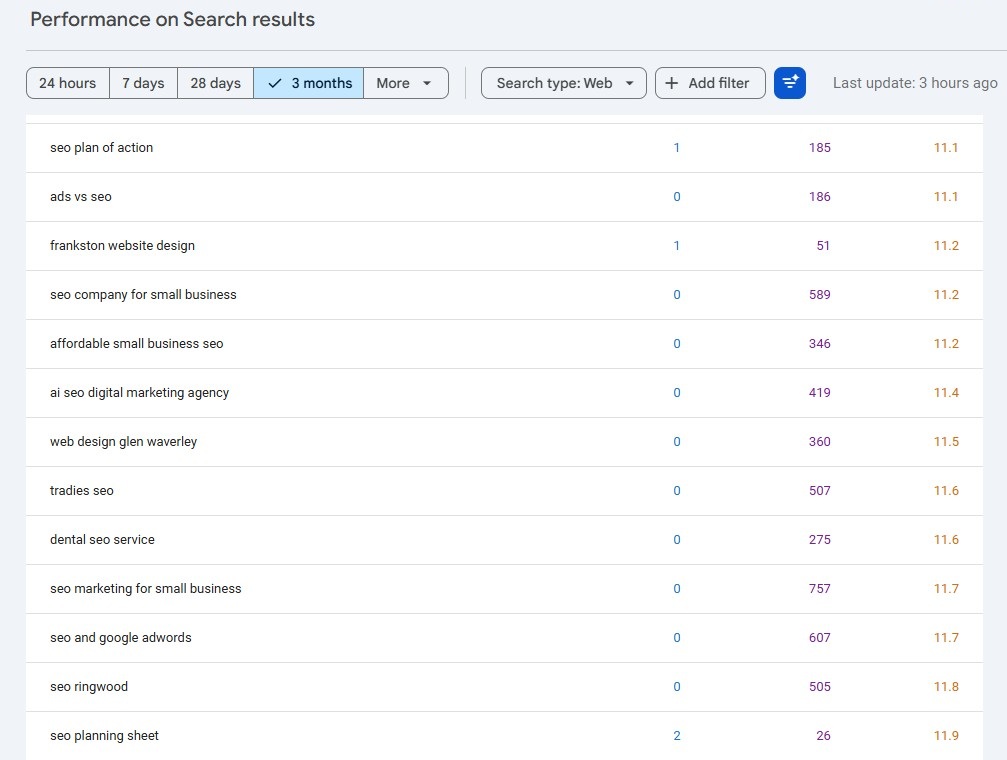
Pay attention to the impressions column while you’re there. A keyword showing in position 14 with 400 monthly impressions is a very different opportunity from one sitting in position 14 with 10 impressions. Both are page 2 rankings. One of them is worth your time.
What you actually do with that list
Finding the keywords is step one. What comes next depends on the page.
Check which URL is actually ranking for the term — Search Console will show you. Sometimes it’s not the page you’d expect. A blog post outranking the relevant service page, or the homepage picking up a query it has no business answering. When that’s the case, the fix is usually an internal link or a redirect pointing Google toward the right place. Quick to do once you know it’s happening.
If the right page is ranking but stuck on page 2, that’s a different problem. Read it honestly.
Does it actually answer the search query better than what’s on page 1? Not just contain the keywords — actually address what someone searching that term needs to know. Thin content, vague copy, and pages that skim the surface are probably why it’s sitting at position 15 instead of position 5. Rewrite the relevant sections with more depth, more specificity, and a clearer answer to the question.
A final thing — and this is one people often skip — is internal links. A page stuck on page 2 sometimes just needs more pages on your own site pointing to it. Find three or four related blog posts or service pages and add a natural contextual link to the target page from each. That alone can shift a ranking, faster than most SEO tactics.
Need help with all this? Our SEO agency can identify your page 2 keywords so you know what the “quick wins” are, as well as putting together a longer-term strategy to help your brands’ online visibility continue to grow strongly.
Why this works faster than starting fresh
A new page targeting a competitive keyword can take six to twelve months to gain real traction. A page already sitting in position 13 might move to position 6 in six to eight weeks with the right updates — sometimes faster. The signal is already there. You’re amplifying it, not building it from nothing.
Google Search Console gives you a free, direct window into exactly which searches are on the cusp. The data is sitting there. Whether you use it or not is entirely up to you.
Share this article
A quick overview of the topics covered in this article.
Latest articles
October 11, 2026

October 11, 2026