
SEO Results Timeline: How Long Does SEO Take for Melbourne Businesses?
The question comes up in almost every first conversation: how long before we see results? It’s a fair ask. You’re committing budget for twelve months and you want some sense of what you’re getting into. The honest answer is that it depends on a few things — but there’s a more useful way to frame it than that.
Most Melbourne businesses start seeing meaningful movement somewhere between three and six months. Not a flood of new enquiries, not a page one takeover — just a keyword or two showing up in the top ten where there was nothing before, impressions in Search Console starting to climb. It’s underwhelming if you were expecting more. It’s also a sign things are working.
Month One to Three: Nothing Visible, But Not Nothing
The first few months of a campaign are largely invisible from the outside. There’s a lot happening — technical cleanup, on-page work, content going live — but Google doesn’t react immediately. It crawls, it indexes, it reassesses. A site that’s been around for ten years with a decent backlink history moves through this faster than one that launched eighteen months ago and hasn’t been touched since.
This is the phase where impatient clients start getting nervous. Understandably. But pulling the pin at month two is roughly equivalent to cancelling a renovation because the walls are still down.
Month Three to Six: Early Signals
Rankings start moving. Usually the lower-competition, longer-tail keywords first — the suburb-specific searches, the niche service queries. For a Melbourne business, this might mean ranking well for “SEO agency Mount Waverley” before making any ground on “SEO agency Melbourne.” That’s not a failure. It’s how the process works, and that suburb-level visibility is genuinely useful traffic, not a consolation prize.
Organic traffic typically starts ticking up in this window too, though the numbers can feel underwhelming relative to what’s coming later. The curve is not linear. Early gains are small, then they compound.
Melbourne Is Not a Single Market
This is worth saying clearly because a lot of generic SEO advice treats a city as one thing. Melbourne isn’t. The legal and dental sectors in the CBD and inner suburbs are among the most competitive search environments in Australia. Law firms and specialist clinics have been investing in SEO for years, and the page one incumbents are well-established. Breaking in takes longer and requires more — more content, stronger links, tighter on-page work.
Trades are a different story. Electricians, plumbers, and builders in the outer eastern and southeastern suburbs are often competing against businesses that have done very little SEO at all. The Map Pack in those areas can be cracked inside six months with consistent effort. The same campaign strategy that takes eighteen months to show results in South Yarra might deliver page one visibility in Pakenham by month four.

None of this means outer suburbs are easy or inner suburbs are impossible. It means your timeline is partly a function of your postcode and your industry, and any agency quoting you a firm result date without knowing both probably hasn’t thought it through.
Month Six to Twelve: Where It Gets Interesting
Compounding is the right word. Content published in month two starts accumulating authority. Links built in month three start passing value. The site’s topical depth starts signalling to Google that this is a legitimate resource for a given set of queries, not just a page with keywords on it.
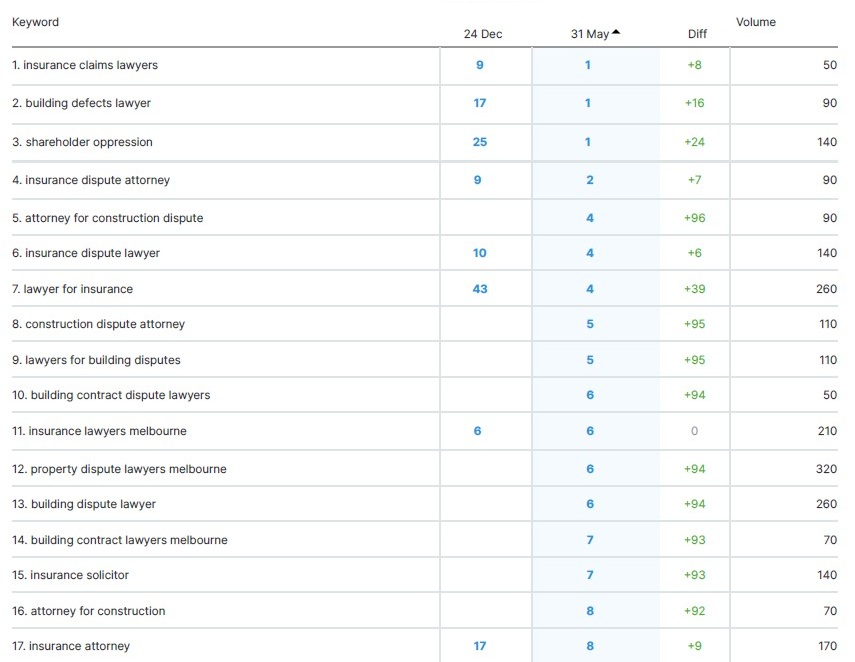
For competitive Melbourne searches — anything with real search volume and established players on page one — this is when you start making inroads. Cracking the top five for a term like “SEO agency Melbourne” from a standing start inside twelve months is possible, but it’s not typical. Getting onto page one is a more realistic benchmark. Staying there and building on it is a year-two conversation.
What Makes the Timeline Longer
Technical problems slow everything down. Crawl issues, duplicate content, pages so thin Google doesn’t know what to do with them — none of that gets skipped over just because you’ve started a campaign. It has to be fixed first, which eats into the timeline before any real building begins. A brand new domain is slower again, because authority doesn’t transfer from anywhere. You’re starting cold.
The competitive set matters too. Breaking into a niche where the page one incumbents have been publishing content and building links for five years is a different job to one where nobody’s really tried. Both are doable. Neither is the same timeline.
Geography plays a role in Melbourne specifically. The inner suburbs and CBD are more competitive than the outer rings. Ranking in Fitzroy or South Yarra for a popular service category is a different challenge to ranking in Berwick or Pakenham for the same thing. Neither is easy, but they’re not the same fight.
There are a range of factors that can influence the timeline:
- Your website has never had any SEO work done on it
- You’re in a high-competition niche like law, dental, or finance in the inner suburbs
- Your domain is less than two years old with little to no backlink history
- There are significant technical issues on the site (slow load times, crawl errors, duplicate content)
- Your Google Business Profile is incomplete, unclaimed, or inconsistently listed across directories
- You’re targeting high-volume, broad keywords from the start rather than building up through longer-tail terms first
- Previous SEO work used low-quality tactics that Google has since penalised
- Content on the site is thin, outdated, or duplicated across multiple pages
- You’re competing against businesses that have been investing in SEO consistently for three or more years
- The site hasn’t been updated or added to in a long time, signalling low activity to Google
What Your Reports Should Show at Each Stage
A monthly report is one of the better ways to tell whether a campaign is actually progressing or just running. Here’s roughly what to expect at each phase, and what to push back on if it’s missing.
In the first three months, the report should be showing technical work completed, on-page changes made, and baseline keyword positions established. If there’s no baseline, you have nothing to measure against later. Traffic numbers at this stage are close to meaningless — don’t get distracted by them.
By month four or five, you want to see keyword movement. Not necessarily big jumps, but directional progress on the terms you’re targeting. Impressions in Google Search Console should be climbing. If rankings are completely flat across every tracked keyword at month five, that’s worth a conversation.
Month six onward, the report should be connecting rankings to traffic and traffic to something real — enquiries, calls, form submissions. An agency that keeps reporting position changes without ever talking about what those positions are delivering is measuring the wrong thing, or hoping you don’t notice the difference.
The Part Most Agencies Don’t Mention
Stopping doesn’t immediately undo twelve months of work. Rankings don’t disappear overnight. But they do slip — gradually, then faster — as competitors keep publishing and Google keeps reassessing who deserves to be where. The businesses that hold their positions long-term aren’t necessarily the ones who started with the best site. They’re usually the ones who never fully stopped.
It’s also important to note that between months 6 and 12, it is very common to see SEO rankings volatility, as Google really notices your site, and starts to re-evaluate it more carefully. Drops and rises across days and weeks are normal, and gradually settles.
If you’re ready to get a clearer picture of where your site stands and what a realistic timeline looks like for your business, book a free SEO Gameplan session. It’s a proper audit and strategy conversation, not a sales pitch dressed up as advice.
Share this article
A quick overview of the topics covered in this article.
Latest articles

October 5, 2026

October 5, 2026