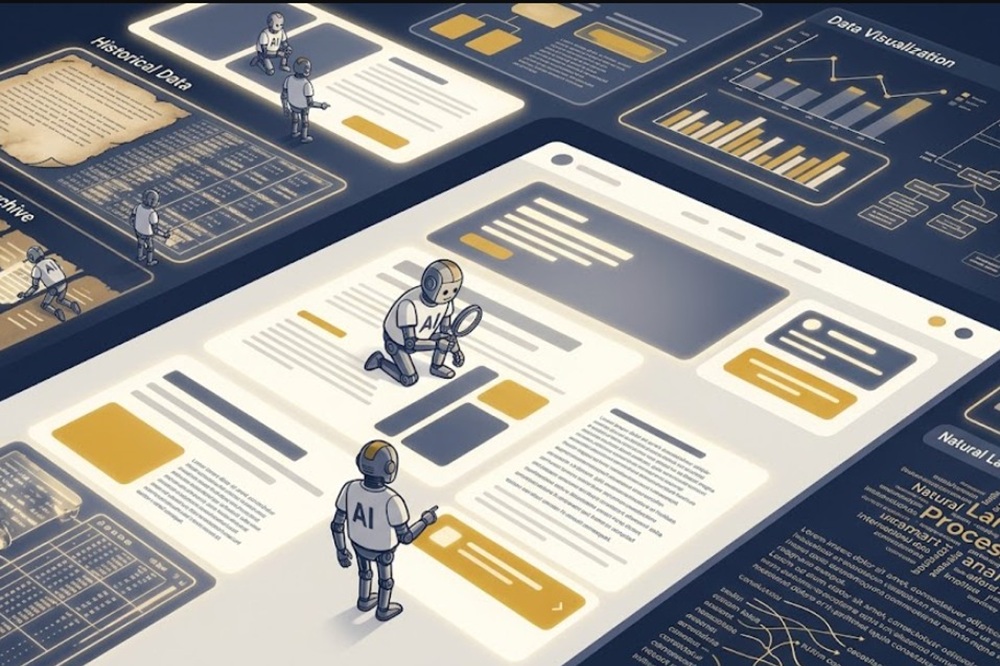
You might have noticed that search results are changing. It feels like AI is taking over, and honestly, it’s making things a bit different for websites. Your homepage used to be the star, but now, AI search engines seem to prefer the pages that go into detail. This article is about why those specific, in-depth pages, often called Deep Content Pages, are becoming more important than ever for getting seen online.
Key Takeaways
- AI search engines are focusing on specific pieces of information, not just whole pages. This means detailed content is getting a boost.
- Homepages are often too general for AI. They give an overview, but AI wants direct answers found on dedicated pages.
- Deep Content Pages are great because they focus on one topic, showing AI you’re an expert in that area.
- To get noticed by AI, structure your content clearly. Think: heading, direct answer, then more details.
- It’s not just about keywords anymore; AI looks at the meaning and connections within your content to decide what’s trustworthy and relevant.
Understanding AI’s Shift Towards Specificity
It’s clear that the way search engines operate is undergoing a significant transformation. Gone are the days when simply stuffing keywords onto a homepage was enough to capture attention. Artificial intelligence is fundamentally changing the game, prioritising depth and precision over broad strokes. This shift means we, as marketers and content creators, must adapt our strategies to align with how these advanced systems now interpret and rank information.
Chunk-Level Ranking: The Core of AI’s Information Retrieval
Think of AI search not as reading a whole book at once, but as dissecting it into individual paragraphs or even sentences to find the exact piece of information needed. This is the essence of chunk-level ranking. Instead of evaluating your entire webpage as a single entity, AI algorithms break down your content into smaller, digestible segments, or ‘chunks’. They then assess each chunk’s ability to directly answer a specific user query. This means a single, well-crafted paragraph explaining a complex concept can, in some instances, be ranked higher than an entire, sprawling article that touches on the same topic but lacks that same focused clarity.
- Context Completeness: Does the chunk provide enough information to be understood on its own?
- Entity Alignment: Are the key people, places, or things mentioned relevant to the topic?
- Semantic Relevance: Does the chunk truly grasp and address the meaning behind the user’s query?
Semantic Relevance Over Keyword Density
While keywords still play a role, their importance has evolved. AI is far more sophisticated than simply counting word occurrences. It now focuses on semantic relevance – understanding the actual meaning and intent behind a search query. This involves natural language processing (NLP) to decipher the ‘why’ behind the search, not just the ‘what’. For instance, a query like “best way to prune roses” isn’t just about the words; the AI understands the intent is a ‘how-to’ guide and looks for content structured with clear, actionable steps. Keyword density is becoming less important than how well your content’s meaning aligns with the user’s underlying need.
The AI’s goal is to match the ‘shape’ of your content to the ‘shape’ of the user’s need. This requires a nuanced understanding of language and context, moving far beyond simple keyword matching.
Prioritising Information Density for Direct Answers
AI search prioritises content that is information-rich and directly addresses a user’s question. This doesn’t necessarily mean longer content is always better. A concise, well-structured paragraph that delivers a clear, accurate answer can often outperform a lengthy article that buries the key information. The AI seeks out the most efficient and effective source for a direct answer. Therefore, focusing on creating highly dense, informative ‘chunks’ of content that can stand alone and provide immediate value is paramount for visibility in AI-driven search results.
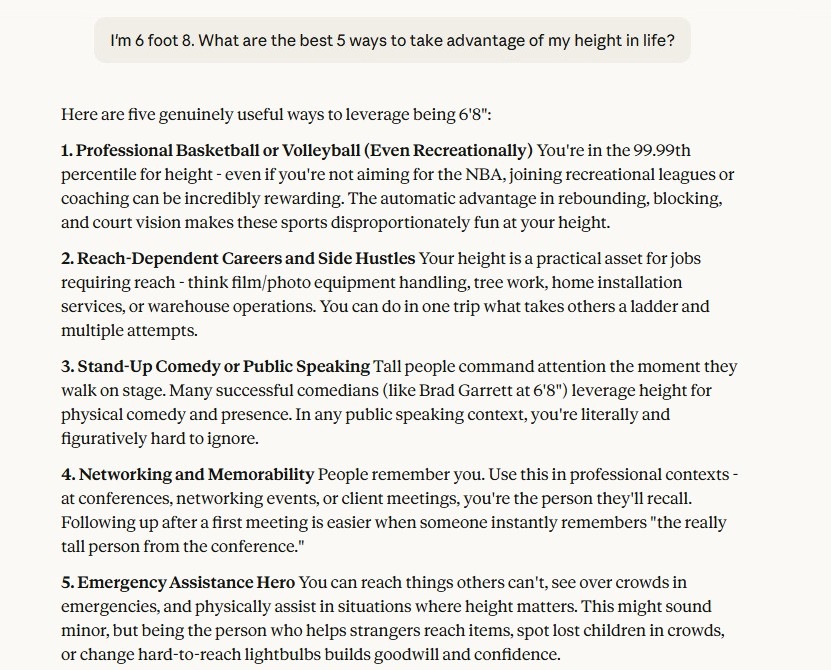
The Diminishing Dominance of Homepages
You might have spent considerable effort crafting a beautiful, well-designed homepage. It probably serves as a grand introduction to your brand, outlining your mission and showcasing your broad range of services. However, in the evolving landscape of AI-driven search, this central hub is increasingly losing its ranking power. AI prioritises specificity, and homepages, by their very nature, tend to be generalist.
Why Homepages Lack Granular Detail for AI
Think about your homepage. It’s a high-level overview, a digital business card. It speaks to the ‘what’ and ‘who’ of your organisation, but rarely the ‘how’ or ‘why’ in the granular detail an AI crafter of answers needs. AI SEO plays into the fact that AI search engines are designed to extract specific information to answer precise queries. A homepage, with its broad strokes and multiple calls to action, simply doesn’t contain the focused, detailed content that AI algorithms are now trained to identify and surface.
The AI’s Preference for Authoritative ‘Information Chunks’
AI search is moving towards identifying and presenting ‘information chunks’ – discrete pieces of content that directly address a specific user need. These chunks are often found within deep content pages, like blog posts, detailed product pages, or comprehensive guides. These pages are built with a singular purpose: to answer a particular question or solve a specific problem. This focused approach makes them ideal candidates for AI to extract and present as direct answers, bypassing the need for users to sift through a broader homepage.
Homepages as Broad Overviews, Not Specific Solutions
While a homepage is vital for brand introduction and overall site navigation, it’s not typically structured to provide the direct, factual answers AI seeks. It’s like asking a general practitioner for highly specialised surgical advice; they can give you an overview, but you’d be better off consulting the specialist. AI is increasingly acting as that specialist, seeking out the pages that have dedicated themselves to a particular topic or question. This shift means that while your homepage remains important for user experience and brand building, its role in direct AI-driven search visibility is diminishing in favour of more specialised, in-depth content.
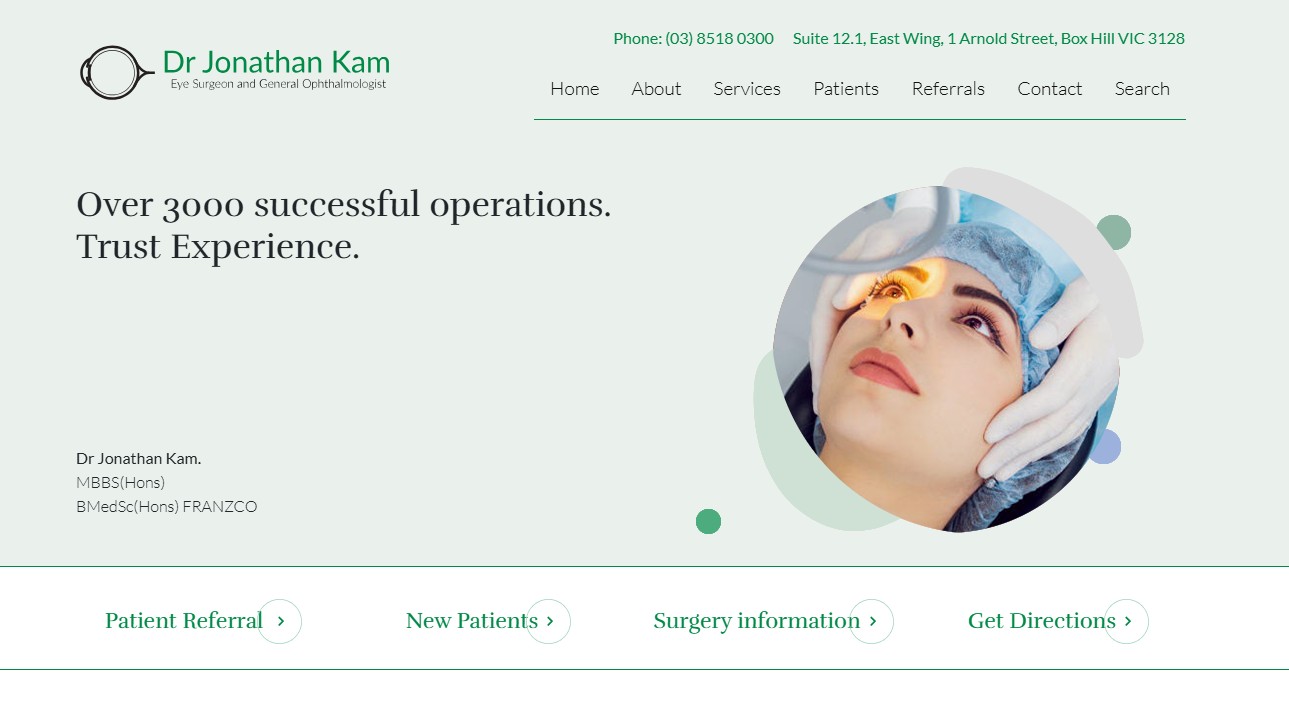
Deep Content Pages: The New Frontier for AI Authority
Forget the homepage as your primary digital billboard. In the evolving landscape of AI-driven search, your most authoritative content resides not on the front page, but within the specialised, deeply nested content that addresses specific user queries with precision. AI systems are increasingly favouring these granular pages because they demonstrate a focused command of a particular subject, a trait that builds significant topical authority.
Establishing Topical Authority Through Dedicated Pages
Think of your website as a library. While the homepage is the grand entrance, it’s the individual books and sections within that hold the detailed knowledge. AI search engines are now acting like discerning librarians, seeking out the most relevant and authoritative ‘books’ (pages) for specific questions. By creating dedicated pages for distinct topics, you’re essentially curating specialised sections within your library. This consistent focus signals to AI that your site is a reliable source for that particular subject matter. For instance, a page solely dedicated to “optimising images for web performance” will carry more weight with an AI than a general “marketing services” page that briefly touches on the topic.
Meeting Specific User Intent with Focused Content
Users, and by extension AI, are looking for direct answers. When someone searches for “how to troubleshoot a faulty Wi-Fi router,” they don’t want a broad overview of your company’s networking solutions; they want a step-by-step guide to fixing their router. Deep content pages excel here because they are built with a singular user intent in mind. This focus allows for:
- Direct Answer Placement: The core solution can be presented upfront, satisfying the AI’s need for immediate, relevant information.
- Granular Detail: You can explore every facet of the specific problem or question without diluting the message with unrelated information.
- Clear Context: The AI can easily understand the purpose and scope of the page, aligning it with the user’s search query.
The Role of E-E-A-T in Deep Content Validation
AI search prioritises content that demonstrates Experience, Expertise, Authoritativeness, and Trustworthiness (E-E-A-T). Deep content pages are perfectly positioned to showcase these qualities. When a page is dedicated to a specific topic, it’s easier to:
- Showcase Experience: Include case studies, personal anecdotes, or real-world examples related to the specific topic.
- Demonstrate Expertise: Feature author credentials, cite reputable sources, and provide in-depth analysis.
- Build Authority: Consistently produce high-quality content on related sub-topics, creating a strong topical cluster.
- Establish Trust: Ensure accuracy, transparency, and clear sourcing.
The AI’s preference for specificity means that a well-researched, detailed article on a niche subject can outrank a general homepage, even if the homepage belongs to a larger, more established brand. It’s about providing the best answer, not just an answer.
Structuring Content for AI Comprehension
To ensure your content is readily understood and prioritised by artificial intelligence, a deliberate structural approach is paramount. AI systems, much like human readers, benefit from clear organisation. However, AI’s interpretation relies on specific signals that traditional web pages often overlook. We must move beyond simply filling pages with words and instead focus on how those words are presented.
The ‘Heading -> Direct Answer -> Deep Dive’ Framework
This framework is your blueprint for creating content that AI can efficiently process and value. It begins with a clear heading that signals the topic. Immediately following this, provide a concise, direct answer to the presumed user query. This is the ‘information chunk’ that AI search engines are actively seeking. Following this direct answer, you can then elaborate with a deeper exploration of the topic. This structure mirrors how AI retrieves and syntheses information, prioritising immediate utility.
- Heading: Clearly state the subject matter.
- Direct Answer: Provide a succinct, standalone answer to the core question.
- Deep Dive: Expand on the answer with supporting details, context, and related information.
This structured approach ensures that the most critical information is presented upfront, making it easy for AI to identify and extract.
Leveraging Clear Headings and Concise Paragraphs
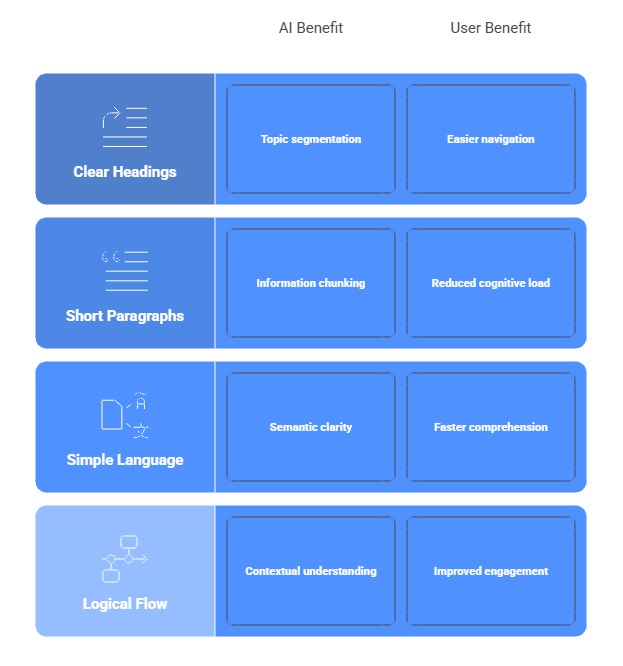
AI algorithms analyse content structure to understand relationships between ideas. Well-defined headings (H2s, H3s, and so on) act as signposts, guiding the AI through your content’s hierarchy. Each paragraph should ideally focus on a single idea or a closely related set of points. This ‘chunking’ of information allows AI to isolate specific pieces of data that directly address a user’s query. Avoid lengthy, rambling paragraphs that cover multiple concepts; instead, break them down into smaller, digestible units.
The AI doesn’t just read your page; it dissects it. Clear headings and focused paragraphs help it understand the ‘what’ and ‘why’ of each section, improving its ability to match your content to a user’s specific need.
Enhancing Readability for Both Users and AI
Ultimately, content must serve human users first, and AI systems are designed to recognise content that is genuinely helpful. Readability is a shared metric. Simple language, short sentences, and logical flow benefit human comprehension and make it easier for AI to parse and interpret your text. Think of it as making your content ‘scannable’ not just for humans scanning for answers, but for AI bots scanning for relevance and authority. This means minimising jargon, using active voice where appropriate, and ensuring a consistent tone.
Beyond Traditional Metrics: AI’s Ranking Signals
Forget the old playbook. While backlinks once held sway, AI search engines are looking far beyond simple link counts to gauge your authority. They’re evaluating a more nuanced set of signals that reflect genuine credibility and how your content fits into the broader digital landscape. Any reputable SEO agency whose finger is on the pulse will tell you it’s about more than just being found; it’s about being trusted and understood by sophisticated algorithms.
The Importance of Entity Clarity and Knowledge Graph Alignment
AI models are increasingly adept at understanding entities – the real-world people, places, organisations, and concepts that populate our information. For your content to rank well, it needs to be clear about which entities it’s discussing. Are you talking about Apple the fruit, or Apple the tech giant? This clarity is vital. When your content accurately identifies and aligns with these entities, it helps AI systems connect your information to their vast knowledge graphs. This means your content is more likely to be surfaced when users are searching for specific, related concepts, not just keywords. Think of it as giving the AI a clear map to your information.
How Internal Linking Builds AI’s Understanding of Your Content
Internal linking is no longer just about helping users navigate your site; it’s a powerful tool for AI comprehension. By strategically linking related pages within your own website, you’re essentially creating a web of context for the AI. This demonstrates the relationships between different pieces of your content, highlighting your topical depth and authority. When an AI can follow these links and understand how your various pages connect and support each other, it builds a stronger picture of your site’s overall expertise. This structured approach helps AI models grasp the nuances of your subject matter, making your content more discoverable for relevant queries.
Citation Confidence: The New Measure of Trust
In the age of AI-generated answers, the concept of ‘citation confidence’ is emerging as a critical ranking signal. AI models are designed to provide accurate and verifiable information. Therefore, they favour content that not only answers a question directly but also demonstrates where that information comes from. This doesn’t necessarily mean a formal bibliography on every page, but rather clear attribution, links to authoritative sources, and a general sense that your content is well-researched and trustworthy. AI is learning to trust content that can be easily verified and cross-referenced. When your content is seen as a reliable source that can be confidently cited by the AI, its ranking potential significantly increases.
Achieving Visibility in AI-Driven Search
It’s no longer enough for your content to simply rank well in traditional search results. With the rise of AI search, the game has fundamentally changed. Visibility now hinges on whether your content is selected and cited by AI engines to form their answers. This means a high ranking in the background doesn’t guarantee user exposure if your specific information isn’t pulled into the AI’s generated response.
From Clicks to Citations: Redefining Search Success
The shift from traditional click-through rates to AI citations represents a significant evolution in how we measure search success. While AI Overviews can sometimes reduce direct clicks to individual pages, they offer a unique opportunity for brand exposure. Being cited within an AI-generated answer acts as a powerful endorsement, signalling authority and trust to a broad audience. This is particularly true for complex or informational queries where AI engines synthesise information from multiple sources.
- Prioritise clarity and direct answers: AI engines favour content that provides specific, easily digestible information.
- Build topical authority: Demonstrate deep knowledge across a subject, not just on isolated topics.
- Structure for citation: Ensure your key insights are presented in a way that AI can confidently extract and attribute.
The ‘Winner-Takes-All’ Dynamic of AI Overviews
AI search results, especially those presented as AI Overviews, often create a ‘winner-takes-all’ scenario. The top-cited sources receive the most attention and brand recognition, pushing traditional organic links further down the page. This dynamic means that even a top-ranking page might see a decline in direct traffic if it’s not featured within the AI’s summarised response. Your relevance scoring and alignment with the AI’s knowledge graph are now paramount.
The goal is to become a trusted source that AI engines want to reference. This requires a strategic approach to content creation and optimisation, moving beyond simple keyword targeting to focus on providing unique, authoritative information.

Future-Proofing Your Content Strategy for Generative Search
To thrive in this evolving landscape, your content strategy must adapt. This involves understanding how AI search engines interpret and utilise information. Focus on creating content that is not only relevant but also structured for easy comprehension by AI. This includes:
- Auditing existing content: Identify and refine pages that directly answer specific user questions.
- Optimising page structure: Employ clear headings and concise paragraphs, presenting answers upfront.
- Focusing on entities: Move beyond broad keywords to clearly define and connect concepts and entities within your content.
By embracing these principles, you can position your deep content pages to be the authoritative sources that AI engines select, ensuring your brand’s visibility in the future of search.
The Takeaway: Your Content’s Future in AI Search
So, what does all this mean for you and your website? It’s pretty clear that the way search engines work is changing, and fast. Homepages, while still important for branding, aren’t the main players anymore when it comes to answering specific questions. Instead, AI is looking for those deep content pages that get straight to the point. You’ve got to make sure your articles are structured well, answer questions directly, and are easy for AI to understand. Think of it like this: you’re not just writing for people anymore; you’re writing for AI too. If you want to be seen and trusted by these new search systems, focus on creating really helpful, specific content. It’s a big shift, but getting it right means your content will be the one AI chooses to share, putting you right in front of users who are actively looking for what you offer.
Frequently Asked Questions
Why are deep content pages better than homepages for AI search?
Think of your homepage like a shop’s front door – it gives a general idea of what the shop sells. A deep content page, however, is like a specific aisle inside the shop that has exactly what you’re looking for. AI search engines are getting smarter and want to give you the most direct answer possible. They find it easier to get that specific answer from a dedicated page that focuses on one topic, rather than a homepage that tries to cover everything.
Does AI ignore smaller websites if they don’t have a lot of brand recognition?
Not at all! While big brands can have an advantage, AI search engines really care about providing the best and most accurate answer. If your smaller website has a really clear, specific, and up-to-date answer to a question, it can absolutely outrank a much larger site. It’s all about the quality and relevance of the information.
How does AI understand what a webpage is about?
AI looks at the meaning behind the words, not just how many times a word appears. It breaks down articles into smaller pieces, like paragraphs or sections, and figures out what each piece is about. It then matches these ‘information chunks’ to what the user is asking, focusing on relevance and how well the content explains a specific idea.
What does ‘chunk-level ranking’ mean for my website content?
Chunk-level ranking means the AI doesn’t just look at your whole webpage as one thing. Instead, it chops up your content into smaller bits, or ‘chunks,’ and ranks those specific bits. This is why having clear headings and focused paragraphs is super important. If an AI can easily understand a small section of your page, it’s more likely to use it to answer a question.
How can I make my content easier for AI to understand?
You can help AI by structuring your content clearly. Use headings and subheadings to organise your topics. Keep your paragraphs short and to the point, and use bullet points or lists when helpful. Think about starting with a direct answer and then explaining it further. This makes it simple for both people and AI to find the information they need quickly.
If my content is used by AI but my website isn’t named, does that still count as ranking?
That’s a great question! If the AI uses your content to build its answer but doesn’t mention your website, you’ve technically ranked well because your information was useful. However, you don’t get the visibility or credit. To truly succeed, your content needs to be structured in a way that the AI feels confident citing you as the source, leading to actual recognition and potential clicks.
Share this article
A quick overview of the topics covered in this article.
Latest articles

October 5, 2026

October 5, 2026