Page 2 to Page 1: SEO Strategies That Actually Move the Needle
If your website is sitting on page 2 of Google, you’re closer to the top than you might think – but you’re also virtually invisible. Studies consistently show that the first page of Google captures over 90% of all search clicks. Page 2 isn’t a consolation prize, but rather a missed opportunity that compounds every single day your competitors stay above you.
The good news is that page 2 rankings aren’t a dead end; they’re a starting point. Unlike trying to rank for a brand new keyword from scratch, keywords sitting in positions 11 to 20 already have momentum. Google has evaluated your content and decided it’s relevant; it just needs a little more convincing.
With the right mix of on-page optimisation, content depth, and targeted authority building, pushing those keywords onto page 1 is one of the highest-ROI moves you can make in SEO. And it’s more attainable than most people realise.
60-Day Page 2 → Page 1 Push SEO Plan
We have put together a 60-day plan that can give you the boost you need to break into the first page. It includes a range of strategies we regularly use in our SEO agency, but if you’re DIYing your marketing efforts, then follow them carefully, and you should reap the rewards.
Week 1-2: Audit & Identify
Goal: Find your best opportunities before touching anything.
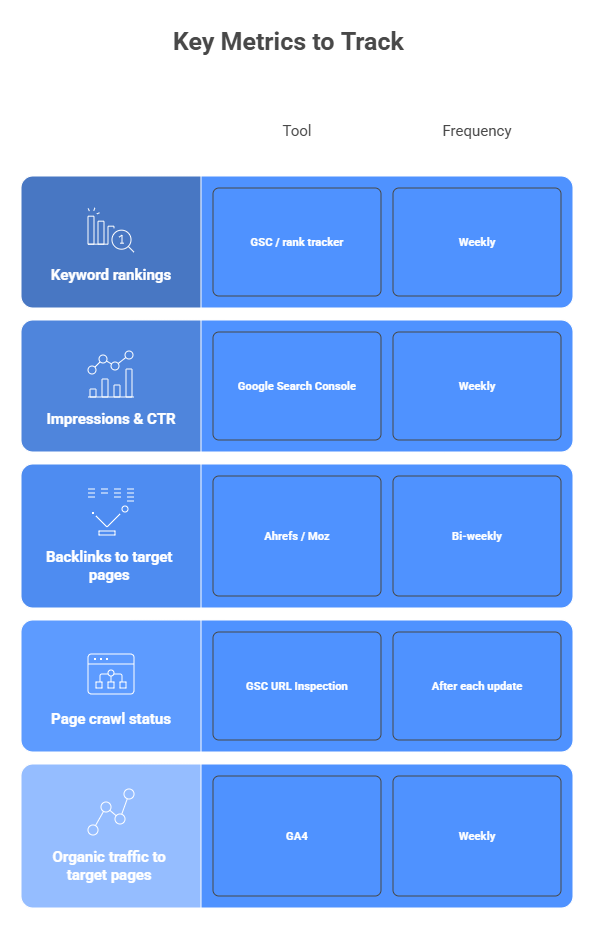
Pull all keywords ranking positions 11–20 from Google Search Console or your rank tracker. Then score each one using this criteria to prioritise:
- Search volume — is it worth winning?
- Current CTR — low CTR at position 11-15 means a title tag fix alone could help
- Page the keyword lands on — is it the right page, or is Google choosing for you?
- Competitor gap — are the pages above you genuinely stronger, or just slightly better optimized?
Target your first 10–15 keywords from this list. Focus on keywords where your page is close — good content, decent backlinks, but just not quite signaling enough relevance or authority.
Week 3-4: On-Page Optimisation
Goal: Make Google more confident your page is the best answer.
For each target page, work through this checklist:
- Title tag — include the primary keyword naturally, add a CTR hook (number, year, benefit). Keep it under 60 characters.
- H1 and subheadings — make sure H2s and H3s reflect related terms and answer follow-up questions searchers have
- Content depth — look at the top 3 ranking pages. Are they covering subtopics you’re missing? Add those sections.
- People Also Ask — pull the PAA box for your target keyword and make sure your page answers those questions explicitly
- Internal links — find 3–5 other relevant pages on the site and add contextual links pointing to your target page with keyword-rich anchor text
- Page speed — if the page is slow, compress images and defer non-critical scripts. A slow page rarely beats a fast one at the margin.

Week 5-6: Authority & Signal Building
Goal: Give Google external proof that your page deserves to rank higher.
- Unlinked brand mentions — find any mentions of the client’s brand or page topic that aren’t linked and do outreach to convert them
- Broken link reclamation — check if any backlinks to this page or similar pages are pointing to 404s and redirect them
- Internal link audit — ensure your highest-authority pages (homepage, cornerstone content) are passing link equity to your target pages
- Seek 2–3 new backlinks per priority page — guest posts, resource page outreach, or supplier/partner links. Even one quality link to a page on the cusp can push it over.
- Social and community signals — share updated pages in relevant communities, forums, or newsletters. Engagement and traffic signals matter.
Week 7-8: Monitor, Adjust & Double Down
Goal: Read what’s working and accelerate it.
- Pull fresh rankings for all target keywords at the day 45 mark
- Identify which pages moved and which didn’t — movement of even 1–3 positions is a good signal that the optimisations are being indexed and processed
- For pages that moved into positions 8–12: do another round of content depth improvements and seek one more backlink
- For pages that haven’t moved: check if Google re-crawled the page (use Search Console’s URL Inspection tool), revisit whether the keyword intent is truly matched, and consider whether a different page on the site is a better candidate
- Set up CTR monitoring — if a page hits page 1 but has low CTR, the next battle is the title tag and meta description
Moving from page 2 to page 1 isn’t luck — it’s a process. By identifying your highest-potential keywords, tightening your on-page signals, building the right links, and monitoring what’s working, you can turn near-miss rankings into consistent organic traffic that compounds over time.
Most pages sitting in positions 11 to 20 are closer to page 1 than their owners realise; they just need the right attention in the right order. If you’d rather skip the trial and error and get straight to results, our team works with businesses every day to do exactly this. Get in touch and we’ll take a look at where your biggest opportunities are hiding.
Share this article
A quick overview of the topics covered in this article.
Latest articles

October 26, 2026

October 26, 2026