How to Structure Your Website Content So AI Assistants Actually Cite You
A new traffic channel showed up in Google Analytics (GA4) recently, one we’d never seen before. A category called “AI Assistant,” separate from Referral or Organic Search.
On our own site, it only accounted for 17 sessions in June, 1.38% of total traffic, but it shows GA4 has started bucketing visits from ChatGPT, Perplexity, Copilot and other AI platforms separately.
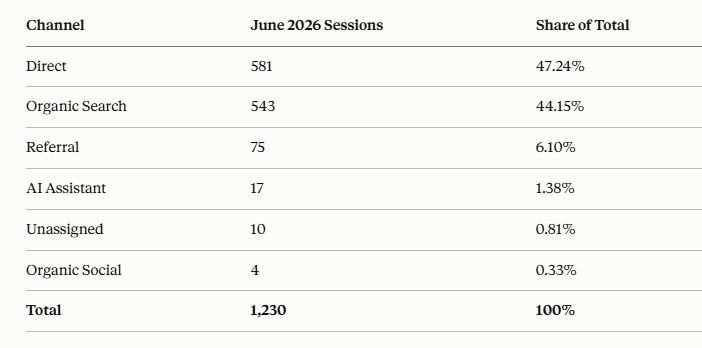
Google’s own measurement team decided it was worth its own bucket rather than folding it into Referral. Worth checking your own GA4 account for the same thing. It might already be sitting there unnoticed.
None of it was there in April or May either, so this isn’t a slow creep we’d been watching build. It’s a category that didn’t exist in our reporting and then did. What it actually reflects is someone asking a question and clicking through to a source cited in the answer, rather than typing a query into Google and scanning ten blue links. A different kind of arrival, running on different rules to ranking.
How AI assistants decide what to pull from
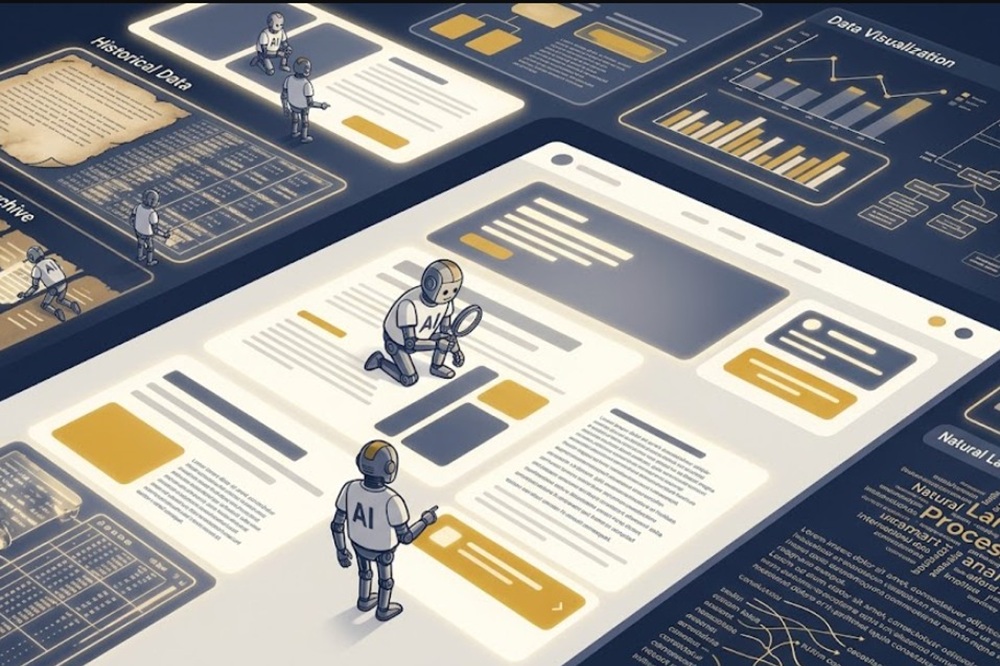
Search engines rank pages. AI assistants extract answers. That’s a genuinely different job, and it changes what “optimised” content looks like.
A page built to rank well in Google can still be badly suited to being quoted by an AI assistant. Long introductions, scene-setting paragraphs before the actual point, and headings that tease rather than answer are all things Google has tolerated for years. An AI assistant scanning a page for a citable answer skips past all of that looking for the paragraph that actually resolves the question.
A few things that make content easier to extract cleanly:
- Answering the question in the first sentence of a section, not building up to it
- Using headings phrased the way someone would actually ask the question, rather than a marketing label
- Keeping the answer to a paragraph a system could lift on its own, without needing three other paragraphs of context to make sense
- Naming the specific thing (a number, a method, a comparison) instead of talking around it
None of that is new advice exactly. Good technical writing has always worked this way. What’s changed is there’s now a second reader in the mix, one that decides in half a second whether to quote your paragraph or skip straight past it.
We saw this exact pattern with a client’s service pages
A client came to us recently with a spread of service pages across several niches, written in-house before they engaged us. On the surface the pages looked fine. Read closely and the same paragraphs repeated across pages with only the industry name swapped out. Generic FAQs, generic objections, nothing that actually sounded like it came from someone who understood that specific trade or profession.

That’s a ranking problem for Google. It’s a bigger problem for an AI assistant. A generic paragraph gives a language model nothing distinctive to attribute, so it either paraphrases from somewhere else or skips the page entirely. Once those pages were rewritten with language specific to each industry (referral pathways for one profession, on-site safety detail for a trade), the content became something worth quoting, not just something worth ranking.
The test we now run on any page: could this exact paragraph sit on a competitor’s site with only the business name changed? If yes, it’s not doing its job for either audience.
Schema is carrying more weight than it used to
Structured data used to be a nice-to-have for rich snippets. For AI assistants, it’s closer to a translation layer. FAQPage schema in particular gives a system a clean, pre-parsed question and answer pair to work with, instead of asking it to guess where a question ends and the answer begins inside a wall of text.
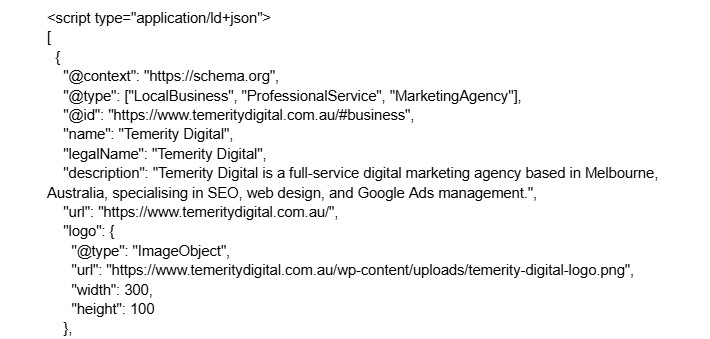
We’re mid-rollout on FAQPage schema across our own service pages right now, alongside the Article and Organization schema Yoast already outputs. It’s slow, deliberate work rather than a plugin toggle, because the schema needs to match content that’s actually structured as genuine Q&A, not retrofitted onto paragraphs that were never written as answers.
Where this can work against you
There’s a version of “AI optimisation” doing the rounds that amounts to stuffing a page with keyword variations and repeating the same fact three different ways in case one phrasing gets picked up. It doesn’t help. If anything, a page that reads like it was assembled for a machine reads exactly that way to the machine too. Repetition, padded lists, and answers that never quite commit to a specific number are the kind of content AI systems are increasingly good at recognising and passing over in favour of something that sounds like it was written by someone who actually knows the subject.
The businesses seeing early traction here aren’t the ones producing the most content. They’re the ones whose existing pages already answer real questions clearly, and who’ve now made those answers easier to find and lift.
A short self-audit
Worth running against your own site before writing anything new:
- Do your headings match a question someone would actually type, or a phrase a marketer would write?
- Does the first sentence under each heading answer it, or lead into it?
- Would a competitor’s name fit into this paragraph as easily as yours?
- Is there a specific number, method, or named process anywhere on the page, or is it all general reassurance?
- Have you checked GA4 for an AI Assistant line item yet?
That last one takes two minutes and tells you whether this is already happening to your site, not just the industry in general.
If you want a proper look at where your service pages stand against this, that’s exactly the kind of audit we perform via our AI SEO service offering.
Share this article
A quick overview of the topics covered in this article.
Latest articles

September 20, 2026

September 20, 2026
September 20, 2026